
The GSGC Formula: Clubs Rooted in Fundamentals
Updated: Jul 22

The GSGC Formula: Clubs Rooted in Fundamentals

Strengthening communities lies at the heart of our mission. Giving youth opportunities to have such a role empowers them to feel valued and needed. It increases their confidence and self-worth by showing them they can make a difference.
The successful implementation of the Giving Back Culture fundamental presents a number of challenges. Mentors must lead their club members to understand, adopt and then voluntarily undertake actions to assist others. This takes time.
Individual Mentors decide how best to approach the Giving Back Culture fundamental in the most relevant and effective way for their club and community. But various approaches have several things in common. They work to ensure club members understand the implications of the Zulu word, ubuntu — the interconnectedness and interdependence of all individuals in a society. They look for examples their youth can relate to. They invite their girls and boys to name the kinds of groups they belong to.

Here are some ways the GSGC-sponsored clubs you support nurture a giving-back culture.
Family Examples
Increasingly, boys are taking on roles traditionally relegated to girls. In discussions on gender equity, Sisonke Boys Club Mentors Nyika Muyambo and Prosper Siphambili introduced the history of gender roles within their Zimbabwean society. Club members learned the roles are not rigid, that anyone can choose to help clean, cook, fetch water or gather firewood. Mentors regularly visit the homes of their youth. On one such visit, the Sisonke Mentors observed a 15-year-old boy assisting his girl nieces with the cooking. This is something he had not done before. “He has changed since he came from the Sisonke meetings,” his mother said.
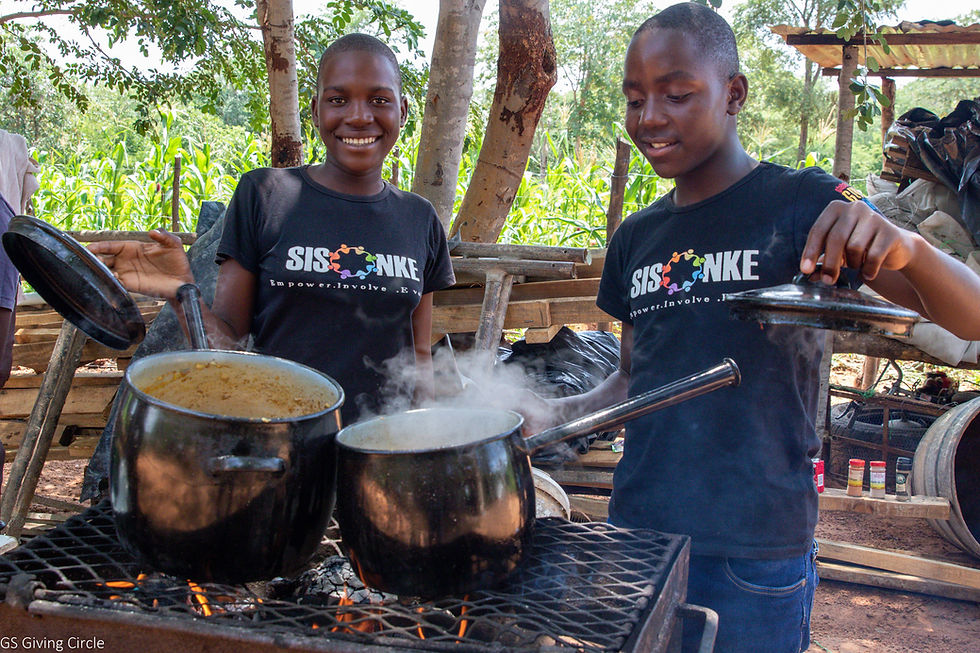
During the pandemic, Sisonke introduced its boys to baking, traditionally a woman’s job. This is a new role boys can now take on within the family.
GSGC girls’ clubs make an effort to include boys in their programming, where appropriate, and boys are increasingly requesting inclusion. To mark Menstrual Hygiene Day, for example, both boys and girls helped with preparing a meal and cleaning up afterward.
GSGC Club Examples
At Girls’ Time Club in Victoria Falls, Zimbabwe, Mentors Procedure Chikosi and Mercy Sibanda report that two alumnae come on weekends to tutor current club members in Mathematics, Science and Computers. It is their way of contributing to their society positively, the Mentors said.

Another Girls’ Time alumna currently studying at university returned to counsel members about post-secondary study. And yet another completed a Professional Baking course, then offered baking lessons to club members. One Girls’ Time Club member even brings her friends together at school and shares information learned in club sessions.
Zimbabwean RiseNShine Clubs alumna, Jada, is training to become a Mentor. She is working with younger children, “Dreamers,” preparing them to join the GSGC program.
Community Examples
Raising Awareness
Mentors understand it is essential to expose their youth to the broad community and its multi-faceted needs. Mentor Fwilane Janery of Project Luangwa in Mfuwe, Zambia recently took girls and boys from her club to an orphanage to learn about its role in society and what the children there experience. Club members then created videos of their impressions.

Mentor Pestrida Muleya of Isepe Girls Club in rural Zambia approached the Lipumpu community Medical Clinic and asked if her club could assist in any way. Eighteen girls joined Pestrida at the clinic on their first visit. The girls had gathered vegetables from their club’s garden to offer to maternity ward patients. After an orientation, the girls set about sweeping the yard and mopping the clinic’s pharmacy. They learned much about both the patients’ and the clinic’s ongoing needs. Mr. Nicholas, the clinic director, thanked the club members, and Pestrida has agreed to take them back again to help.

Early in the pandemic, in response to a nation-wide radio appeal by Zambia’s President, Wayi Wayi Creative Clubs Mentor Agness Buya Yombwe organized teams of club members to pick up trash. Girls’ Time Club in Zimbabwe is now doing the same.
In one Nosy Ankao Girls Club in Madagascar, Mentor Pierrah Rakotoarison reports that three “dynamic” club members affirm their commitment to conservation of marine resources by participating twice a month in a beach clean-up. Nosy Ankao organizes this for students and teachers at a local school. Their combined efforts aim to limit the spread of plastic in the ocean to avoid harming turtles and other marine resources. Mentor Pierrah hopes to implement the same program in three other Nosy Ankao clubs on the mainland.

Food Insecurity
At the pandemic’s onset, Mentors studied the challenges their communities were facing. By far the most urgent was hunger. GSGC clubs didn’t have the resources to donate purchased items, so several decided to grow food — a decision that allowed them to work with youth during COVID-19 school closures. The kale they grew was distributed to club members’ families and the broader community. Wayi Wayi Creatives Clubs, Sisonke Boys Club, Sisonke Girls Club, Isepe Girls Club and Tikobane Girls and Boys Clubs all have created thriving, productive gardens to the benefit of their communities.
Sharing Accurate COVID-19 Information
Throughout the pandemic, GSGC Mentors offered accurate, up-to-date information on the disease to offset communities’ limited or erroneous information. Mentor Gloria Mubita took to the Livingstone air waves with a regular radio program about COVID. Nyika Muyambo of Sisonke Boys Club partnered with the Victoria Falls Task Force on COVID, ensuring reliable information was passed to club members and their families.
Tikobane Library
In Dete, Zimbabwe, Mentor Ndlelende Ncube joined fellow Mentors Dumisani Moyo, Sidunyisiwe Moyo and Themelihle Dhlamini to create a joint library for their girls and boys clubs. They built a structure to house the books they received after being awarded a special grant. Once books were shelved, they opened the library to the Dete community so that all could benefit.

Meeting Educational Needs
Schools were closed, and so Sisonke Boys Club decided to offer classes. The Mentors spoke to Talent Muyambo, a teacher and Nyika’s wife, and she started working with the boys. Soon, community members started bringing in their girls, saying they, too, would benefit from classes, and Sisonke opened its arms to girls. When it did, the community started to get involved with Sisonke as an organization. Talent eventually left the teaching profession, founded Sisonke Girls Club and became its Mentor.
The Future
Each change in the life of GSGC youth is a gift to the community. Mentor Prisca Sakala from Yosefe and Matula Girls Club in Mfuwe, Zambia, invites members’ parents or guardians to witness club activities and give feedback on any positive impact they notice among their girls. One guardian said, “I am proud to report that the club is positively impacting my 10-year-old girl… I feel and believe that your program is of high quality and effective in shaping the future of young girls in rural, poor and vulnerable communities.”

Positioning young people to recognize needs at various levels of society, and then working with them to find ways to meet these needs, this is the goal of GSGC’s third fundamental. It entails not only the community work itself, but also discussions around the expectation that club members use their education, skills and experience to help build their communities.
And this creates a generation of young leaders who embrace the responsibility and teach it to the next generation.


