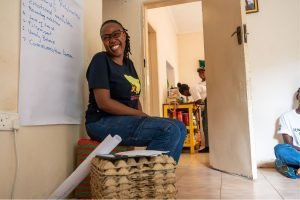
Sunga Martha Mwila: Orphan to Mentor
Updated: Jul 29

“Leave everything and go to school.”
Those were Estellah Mwaba Mwila’s last words to her 12-year-old daughter, Sunga. She and her 7-year-old sister were caring for their ailing mother in a tiny farm house with no electricity or running water in northern Zambia. The three lived off the proceeds of their pumpkin patch, but the harvest had been poor, and there was no money to pay bills. Despite the challenges, Estellah, a primary school teacher, made education a priority.
Sunga’s mother died of tuberculosis four days later. Her father, a pastor who was mostly absent, died six months later. But her mother’s last words stuck with Sunga, and 10 years later, she made her way to Livingstone, in southern Zambia. There, she found a home, an education and acceptance at WayiWayi Art Studio and Gallery, where GSGC sponsors two youth clubs.
Now, Sunga, an upcoming potter, is a WayiWayi Girls Club Mentor, supporting girls with both life lessons and art lessons.

“I think Sunga is an amazingly talented Mentor,” said Racheal Musonda Ng’andu, a Mentor with GSGC-sponsored Believe Club, also in Livingstone, who has been guiding Sunga. “She relates so well to the girls.”
Sunga is one of a growing number of former and current members of GSGC-sponsored clubs who are carrying on or training to carry on the work of empowering girls and changing attitudes about gender equality. Among GSGC’s tenets is to give back, and these young people are doing just that.
In the years after her parents died, Sunga worked hard to stay in school. She lived with her grandfather in northern Zambia, later an uncle in the capital, Lusaka. As an orphan, she was teased and taunted by cousins. Her requests to attend boarding school were turned down for lack of space. She wanted a career in architecture.
Having taken the Grade 10 entrance exams just days after her mother’s death, Sunga qualified, then went on to Grade 11. But because of a glitch signing up for exams the next year, Sunga was unable to take them and had to repeat 12th grade.

When a fall from a moving truck left her with headaches and back pain, concentrating on schoolwork became difficult. Sunga’s mother had taught her how to crochet, and a friend’s mother suggested she crochet discarded plastic bags. Seeing her ability, her uncle suggested she study art. The owner of a local gallery saw her crochet work on a television show, pushed her to excel and introduced her to Agness Buya Yombwe, a well-known Zambian artist who works with various materials.
Agness and her husband, Lawrence Yombwe, own and operate the WayiWayi studio and gallery at their home. Under the WayiWayi name, they run GSGC-sponsored clubs for both girls and boys.
Agness invited Sunga to show her crocheted works in an exhibit at another Livingstone gallery, and eventually, Sunga worked there as a sales clerk, crocheting bags when customers were not in the shop.
But the gallery closed a year later and unable to find stable work back in Lusaka, Sunga studied photography, then worked as a freelance videographer. Her health was precarious, but with only a few Kwacha in her pocket, she left for greener pastures in Livingstone.
It was then that Agness and Lawrence opened their home and gallery to her. And Sunga’s mind opened to the possibility that art was more than drawing.
“We realized that she was sincere, humble and willing to improve her grades. Her interest was art, and where she was staying, they were not allowing her to pursue a career in art,” Agness explained. “She didn’t have people to encourage her to take up a career in art. And after realizing that she was a double orphan, we were willing to assist her. She is hardworking and honest.”
Sunga’s grades improved, and she joined WayiWayi Girls Club. Quiet and soft-spoken, she watched and learned from Mentor Agness. Sunga settled into life at the Yombwe home, and she took an art teacher diploma course on scholarship. She concentrated on pottery and English.

Sunga said she gained confidence as a club member. As a WayiWayi Mentor, she knows it is important to share her knowledge and skills with others as others did when she was struggling. “I am learning to work on myself even as I reach out to the girls,” she said.
That way, she explained, she can listen more closely and better understand each girl and her challenges. That way, they feel more appreciated and affirmed.
As a role model, she is acutely aware of the importance of good communication and time management skills, of accountability and of making sure girls are motivated and feel supported. And she’s working to boost her problem-solving skills.
“That will enable me to deal with situations the girls might approach me with when they come for encouragement, advice and effective solutions,” said Sunga, who often crochets as she chats.

Believe Club Mentor Racheal has come to know Sunga well. “She’s down to earth, willing to learn and not shy to give her opinion,” Racheal said.
Sunga is grateful that Agness and Lawrence believed in her and offered hope when others didn’t.
“I thank God for that miracle,” she said. “I have learnt many beautiful things about art and many harsh truths about myself and life in general.
“I went to study art and English so I can be independent and help girls like me,” Sunga explained. “Most importantly, I want to have a good self-esteem, confidence in what I do and a good relationship with those around me.”